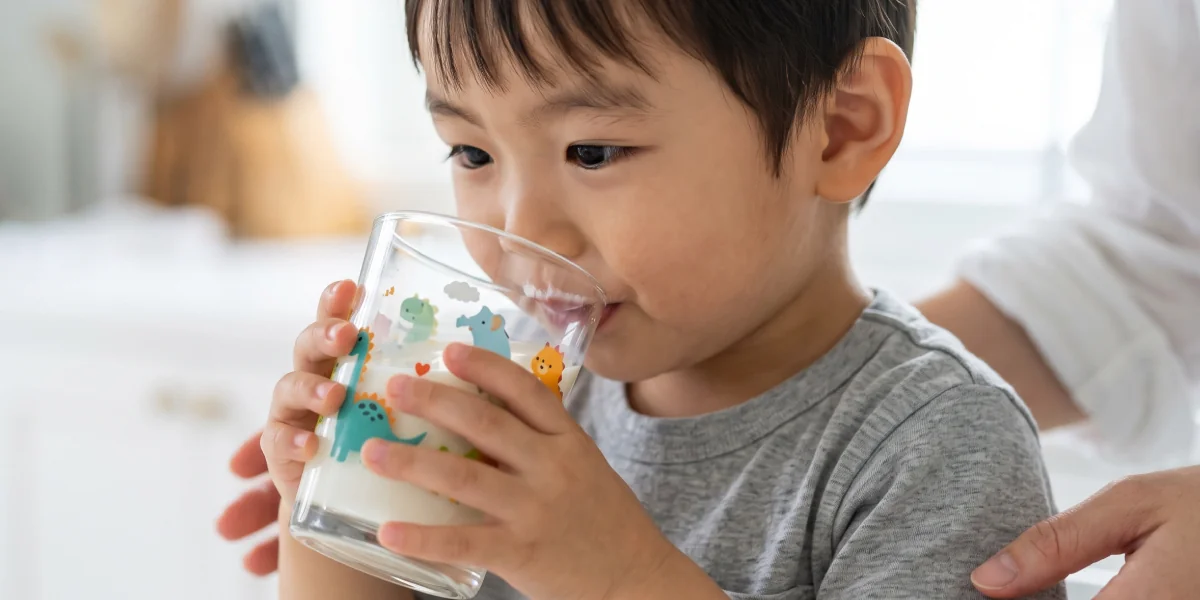
A mother and her son holding a carton of milk. Tip: How to help your child start drinking UHT milk—let them gradually get used to the new taste. By Piyada Ajprajan, Registered Dietitian.

How to Introduce Your Child to UHT Milk: Help Them Gradually Get Used to the New Taste

For healthy children who have turned 1 year old, parents can introduce plain, full-fat UHT milk. If the child refuses to drink it from the carton, try adding small amounts at a time toa cup they’re familiar with and can hold comfortably, then gradually increase the amount of UHT milk little by little without using coercive language such as “You must finish the whole carton” or “Just a little more and it’ll be gone—finish the whole carton.” Additionally, do not pressure or force the child to stop drinking their usual milk when first introducing UHT milk. Instead, incorporate milk into a balanced, age-appropriate diet, as 1-year-olds have increased nutritional and energy needs, which will support their development and growth [1,2].

A toddler drinks milk from a glass

If your child refuses to drink UHT milk, you should start by teaching them to drink from a cup or try a different flavor of milk first.

If your child refuses to drink UHT milk, try to determine whether they are simply unaccustomed to drinking from a cup or to the taste of UHT milk, as 1-year-olds need time to adjust to both new flavors and new ways of eating[2,3] during the early stages of introducing new tastes [4], your child may resist, cry, or refuse to drink UHT milk. Sometimes they’ll just take small sips to taste it or spit it out—which is a normal part of what parents experience with 1-year-olds

Nutritionists recommend making changes gradually, one step at a time. Start by pouring your child’s usual milk into a sippy cup or a cup with a spout, then observe whether your child is willing to drink from it. Parents can observe their child’s behavior and choose an appropriate training method without forcing or pressuring the child, as outlined in the table below.

Behaviors Observed in Children How to Cope and Adjust Your Behavior Appropriately
My child can hold a bottle and drink milk on their own, but they refuse to drink milk from a cup. If your child isn’t used to drinking from a cup yet, try giving them milk in a sippy cup or a cup with a straw. Encourage them to take small sips at a time. Don’t force them—even if they only drink a little, be sure to encourage them and don’t scold them [3]. Try saying, “This cup has a straw with your favorite cartoon characters on it. Why don’t you give it a try?”
My child can drink milk from a cup, but refuses to drink UHT milk. If your child isn’t used to the new flavor yet, try giving them plain UHT milk in small amounts or mixing it with prepared formula. Then gradually increase the proportion as your child adjusts to it [2]
A worried expression, spitting up milk, crying, refusing UHT milk, drinking very little If your child isn’t ready to eat at that moment, take a break and try again when they’re relaxed after doing activities they enjoy. Practice giving them UHT milk at the same time every day. Praise them even if they eat only a little, saying things like, “You’re doing great, sweetie. It’s okay if you can only eat this much.” Parents should drink the same type of milk as their child to set a good example and help the child feel less afraid of new flavors. [5]

Every child takes a different amount of time to adjust. Some start as early as 1 year old, while others begin at 1.5 years old. Therefore, family members should work together to guide the child’s behavior in the same direction to create a positive experience when starting to drink UHT milk.

My child won't drink UHT milk but prefers powdered milk. What should I do?

When a child refuses to drink UHT milk but prefers powdered milk, this is a common problem that parents of 1-year-olds often encounter during the transition to milk. Try helping your child gradually adjust to the new taste by following these steps:

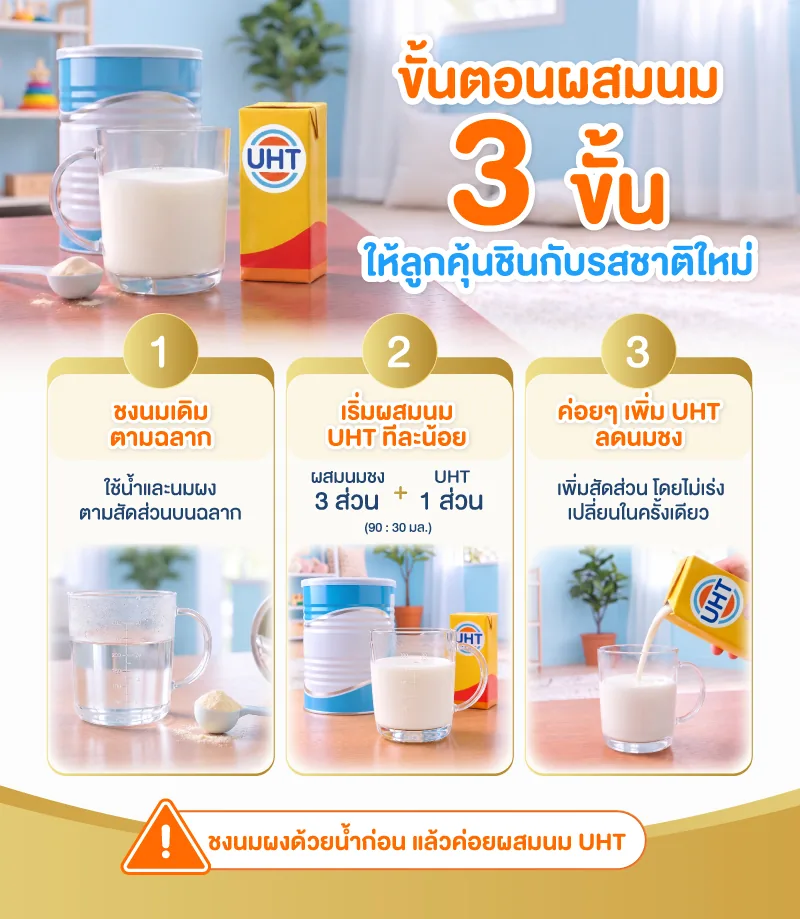
  1. Prepare the formula your child usually drinks by mixing powdered formula with clean water according to the proportions listed on the label. Do not use UHT milk as a substitute for water when preparing the formula, as this will result in a nutrient concentration that is too high for a 1-year-old child [2,6]
  2. Gradually mix UHT milk into the prepared formula. For example, mix 1 ounce of UHT milk into 3 ounces of prepared formula [2]. Slowly increase the ratio based on the parent’s assessment of the child’s tolerance, then gradually increase the amount of UHT milk as the child continues to accept it [2] The transition period varies from family to family. Parents should not stress or rush the process to the point of putting pressure on their child, as this may cause the child to resist and refuse to drink UHT milk.
  3. Add UHT milk until the cup is full. If your child is eating well, gradually reduce the amount of formula without trying to switch completely all at once. [2]
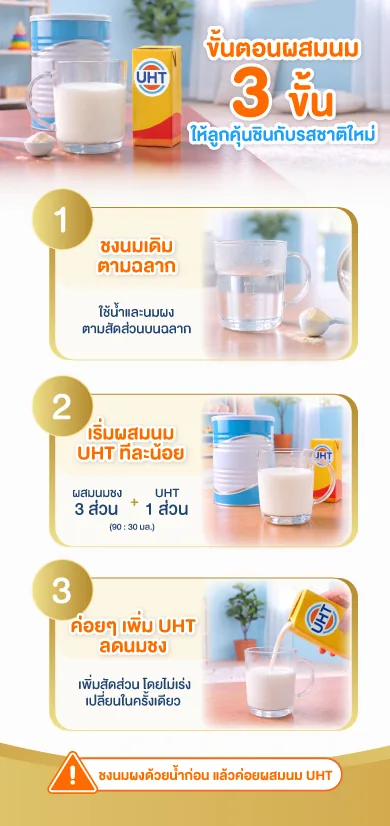
Infographic: 3-Step Formula Mixing Guide to Help Your Baby Get Used to a New Taste: 1. Prepare the regular formula as directed on the label, using water and powdered formula in the proportions listed on the label. 2. Start mixing in UHT milk gradually, using a ratio of 3 parts regular formula to 1 part UHT milk (90:30 mL). 3. Gradually increase the UHT milk and reduce the regular formula, avoiding a sudden change all at once. · Mix the powdered milk with water first, then gradually add the UHT milk

What should a 1-year-old eat when transitioning from formula to UHT milk?

One-year-olds transitioning from formula to UHT milk can eat a variedand balanced diet similar to that of adults to support age-appropriate growth and development. You can plan three main meals and two snacks that are appropriate for a one-year-old. [7] Key nutrients for this age group include iron, which aids in red blood cell production and brain development; calcium and vitamin D, which help build strong bones and teeth; zinc, which supports age-appropriate growth; and iodine, which plays a crucial role in thyroid hormone function and brain development [7,8] Each meal should include rice or starchy foods, meat or eggs, vegetables, fruits, and healthy fats in appropriate proportions[7]. During the initial transition from formula to UHT milk, even if the child drinks only a small amount or refuses to drink it, parents should not force or pressure the child to drink milk [5]. The child may resist and feel upset. Therefore, parents should ensure the child eats age-appropriate foods to receive sufficient energy and nutrients each day

If my child doesn’t drink UHT milk during the transition to a new formula, will they get enough nutrients?

If your child refuses to drink UHT milk during the transition period, parents should assess whether the child’s daily intake of nutrients is sufficient. Since 1-year-olds require a variety of nutrients in addition to milk, you should ensure your child eats foods from all five food groups and supplement the child’s usual milk with UHT milk. During the initial transition to UHT milk, the child may not yet be accustomed to the new taste. [2]If a child’s diet lacks variety, it may result in inadequate nutrient intake, which can affect growth, neurological and brain development, the immune system, and the child’s psychosocial development. Essential nutrients, vitamins, and minerals for 1-year -olds include carbohydrates, protein, fat, calcium, iron iodine, vitamin A, zinc, folate, and vitamin D [7,9]. Therefore, if your child eats the same meals every day, picks only what they like, and refuses to eatthe variety of foods served on their plate, parents should consider choosing UHT milk that is highly nutritious and contains essential nutrients appropriate for 1-year -olds to help support their development and growth in line with their age.

Piyada Ajprajan, author of the article

Piyada Ajapajarn

Written by:

Registered Dietitian
(Registered Dietitian; RD)

Piyada Ajprajan, author of the article

Piyada Ajapajarn

Registered Dietitian
(Registered Dietitian; RD)

Piyada Ajprajan, author of the article
Written by:

Piyada Ajapajarn

Registered Dietitian
(Registered Dietitian; RD)

reference

  1. 1. Centers for Disease Control and Prevention. Cow’s milk and milk alternatives [Internet]. Atlanta (GA): CDC; April 16, 2026 [cited Oct. 2, 2026]. Available from: https://www.cdc.gov/infant-toddler-nutrition/foods-and-drinks/cows-milk-and-milk-alternatives.html
  2. 2. Cleveland Clinic. Baby steps: tips for transitioning from formula to milk [Internet]. Cleveland (OH): Cleveland Clinic; May 6, 2024 [cited Oct. 2, 2026]. Available from: https://health.clevelandclinic.org/transition-from-formula-to-milk
  3. 3. Shu J. From bottle to cup: helping your child make a healthy transition [Internet]. Itasca (IL): American Academy of Pediatrics; July 3, 2023 [cited Oct. 2, 2026]. Available from: https://www.healthychildren.org/English/ages-stages/baby/feeding-nutrition/Pages/Discontinuing-the-Bottle.aspx
  4. 4. Centers for Disease Control and Prevention (CDC). Tips to help your picky eater [Internet]. Atlanta (GA): CDC; April 14, 2026 [cited October 13, 2026]. Available from: https://www.cdc.gov/nutrition/features/help-picky-eater.html
  5. 5. East of England Community Health and Care NHS Trust. Helping your child accept new foods [Internet]. [place unknown]: NHS; Nov. 1, 2024 [cited Oct. 13, 2026]. Available from: https://bedslutonchildrenshealth.nhs.uk/services/bedfordshire-and-luton-childrens-nutrition-and-dietetics-service/helping-your-child-to-accept-new-foods/
  6. 6. U.S. Food and Drug Administration. Handling infant formula safely: what you need to know [Internet]. Silver Spring (MD): U.S. Food and Drug Administration; [cited Oct. 13, 2026]. Available from: https://www.fda.gov/food/buy-store-serve-safe-food/Handling Infant Formula Safely: What You Need to Know
  7. 7. Office of Health Promotion, Department of Public Health; Office of Nutrition, Department of Public Health. Nutrition for All Life Stages [Internet]. Nonthaburi: Department of Public Health; 2562 [Accessed October 13, 2569]. Available from: https://multimedia.anamai.moph.go.th/oawoocha/2019/07/HP-eBook_02.pdf
  8. 8. Centers for Disease Control and Prevention (CDC). Vitamins and minerals [Internet]. Atlanta (GA): CDC; April 1, 2024 [cited Oct. 13, 2026]. Available from: https://www.cdc.gov/infant-toddler-nutrition/vitamins-minerals/index.html
  9. 9. Massey M, Barren JJ, Vijaybhai CV. Early childhood nutrition and its impact on growth and development: a review. SDES Int J Interdiscip Res. 2025;6(6):1241-1243. doi:10.47997/sdes-ijir/6.6.2025:1241-1243.
  10. 10. U.S. Department of Health and Human Services, U.S. Department of Agriculture. Dietary Guidelines for Americans, 2025–2030. 10th ed. [Internet]. Washington, D.C.: U.S. Department of Health and Human Services and U.S. Department of Agriculture; Jan. 2026 [cited Oct. 13, 2026]. Available from: https://cdn.realfood.gov/DGA.pdf
  11. 11. Cleveland Clinic. Sugar: How Bad Are Sweets for Your Kids? [Internet]. Cleveland (OH): Cleveland Clinic; July 5, 2024 [cited Oct. 22, 2026]. Available from: https://health.clevelandclinic.org/sugar-how-bad-are-sweets-for-your-kids
  12. 12. Center for Food Safety. UHT milk: what it is and how to store it [Internet]. Food Safety Focus. March 2026;236(4) [cited Oct. 13, 2026]. Available from: https://www.cfs.gov.hk/english/multimedia/multimedia_pub/multimedia_pub_fsf_236_04.html
  13. 13. American Academy of Pediatrics. Brush, book, bed: how to structure your child’s nighttime routine [Internet]. Itasca (IL): American Academy of Pediatrics; [cited Oct. 4, 2026]. Available from: https://www.healthychildren.org/English/healthy-living/oral-health/Pages/Brush-Book-Bed.aspx

Frequently Asked Questions

Try to see if your child is having trouble using a cup or doesn’t like the taste of milk by observing their behavior, such as
  1. My child can hold a bottle and drink milk on their own, but they refuse to drink milk from a cup.
  2. My child can drink milk from a cup, but won't drink UHT milk or
  3. A worried expression, spitting up milk, crying, refusing UHT milk, drinking very little
Help your child gradually adjust to the new taste by slowly mixing small amounts of UHT milk with powdered milk, gradually increasing the amount of UHT milk and reducing the amount of powdered milk so that your child gets used to the taste.
A 1-year-old child transitioning from formula to UHT milk can eat a varied and balanced diet similar to that of an adult to support age-appropriate growth and development. You can provide three main meals and two snacks per day that are appropriate for a 1-year-old.
Parents should assess whether their child’s daily intake of nutrients is sufficient, as one-year-olds need a variety of foods in addition to milk. They should ensure their child eats foods from all five food groups and supplement the milk the child is accustomed to with UHT milk.

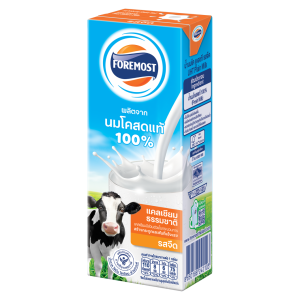
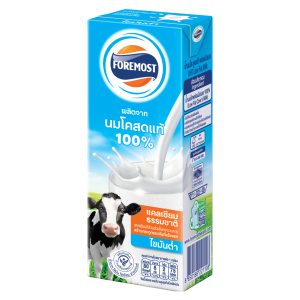
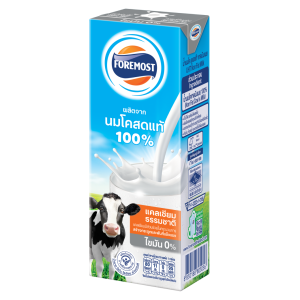
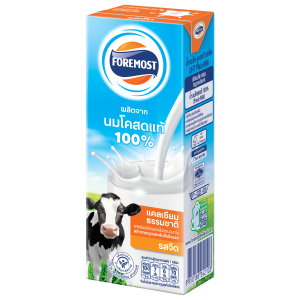
Foremost milk tasteless

Formost Plain Milk, made from 100% fresh cow's milk

Made from 100% real fresh cow's milk.

View more product details

Share

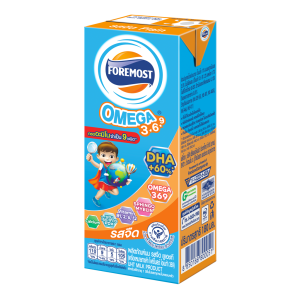
Add to cart now! Get an instant discount of 20 baht per case on Foremost Omega 369 Original Flavor, 180 ml.

Accumulate purchase points, upgrade your membership level, and receive exclusive additional discounts.

The first 220 orders: Spend 2,990.- and get a free Omega Smart Inventor Explorer Table worth 890.-!

Members can use discount coupons at checkout when purchasing items totaling 1,000 baht or more.