Home /
Articles /
Child Development /
What Is the “Terrible Twos”? Why Do 2-Year-Olds Act Up and Want to Do Things on Their Own, and How Should Parents Handle It?
What is the “terrible twos”? Why do 2-year-olds act up and insist on doing things on their own, and how should parents handle it?
“The ‘Golden Age of 2’” is a term used to describe the period around age 2 when children begin to assert their individuality and desire for greater independence—for example, wanting to make their own choices, trying to do things on their own, and possibly refusing, crying, or throwing tantrums when they don’t get what they want. This term is similar in meaning to the English phrase “Terrible Twos,” which refers to the stage when children begin to show a greater desire for independence [6]
Around age 2, parents may begin to notice behaviors such as saying “no,” wanting to do things on their own, becoming upset when told “no,” or crying when they have to stop an activity they’re enjoying [3,6]. Children’s desire for independence is growing, while their language skills, emotional regulation, and ability to respond appropriately are still developing [2,3].
From a behavioral perspective, dealing with the “terrible twos” isn’t just about getting your child to stop crying or refusing to cooperate. Instead, you should observe the situations in which these behaviors occur, what your child needs at that moment, and what kind of help they require. This will enable parents to help their child communicate their needs more clearly, while also setting clear boundaries regarding safety and necessary routines.
Why do 2-year-olds start wanting to do more things on their own?
At age 2, children become more curious, move more freely, and are better able to communicate their needs. As a result, they often want to explore, experiment, and try doing many things on their own—such as holding a cup by themselves, putting on their own shoes, choosing their own toys, or wanting to join in on activities that adults are doing [2]
When a child refuses or is unwilling to do something, it may not always be because they’re being willful; it could be their way of saying they don’t want to do it or that they want to have more say in the decision.
When it comes to giving children a say, parents can provide opportunities for their children to participate in decision-making within limits set by adults. For example, instead of asking, “Do you want to put on your shoes?” when it’s time to leave the house, you could say, “It’s time to put on your shoes. Do you want to put them on yourself, or would you like Mom to help?” Allowing children to participate in making choices within boundaries set by adults aligns with the American Academy of Pediatrics (AAP), which recommends that 2-year-olds be given the opportunity to choose from appropriate options [2]
Why do 2-year-olds cry or throw tantrums so much when they don’t get what they want?
Two-year-olds are learning what they can and cannot do. At the same time, their ability to control their emotions and regulate their own responses is still developing, and some children may not yet be able to clearly express what they want or how they feel. As a result, parents may encounter challenging behaviors such as crying, throwing themselves on the floor, pulling on objects, or hitting when they don’t get what they want [3]
From a behavioral analyst’s perspective, rather than simply focusing on how to stop crying, throwing tantrums, or hitting, parents can try to observe in what kinds of situations their child tends to cry, throw tantrums, or hit, what the child is trying to communicate, and how they can help the child express their needs more clearly.
If your child often cries, throws a tantrum, or hits when told to stop playing or when they don’t get what they want, parents can try following these three steps:
Notice what kinds of situations trigger this behavior —for example, when the child is told to stop playing or when they don’t get what they want.
See what kind of help your child still needs, such as waiting, transitioning between activities, or communicating their needs.
Help your child practice skills that address the specific areas where they still need assistance. For example, if your child still has trouble expressing their needs clearly, you can model short phrases such as “More,” “Help,” or “No” to give your child a way to communicate that’s more appropriate for their current language level, rather than relying on challenging behaviors to get others to understand their needs.
How can parents cope with the "terrible twos "?
Dealing with a 2-year-old doesn’t mean preventing your child from crying or getting upset every time, but rather helping them gradually develop ways to communicate, participate in decision-making, and learn appropriate behavior within clear boundaries. Parents can start by focusing on everyday situations and routines.
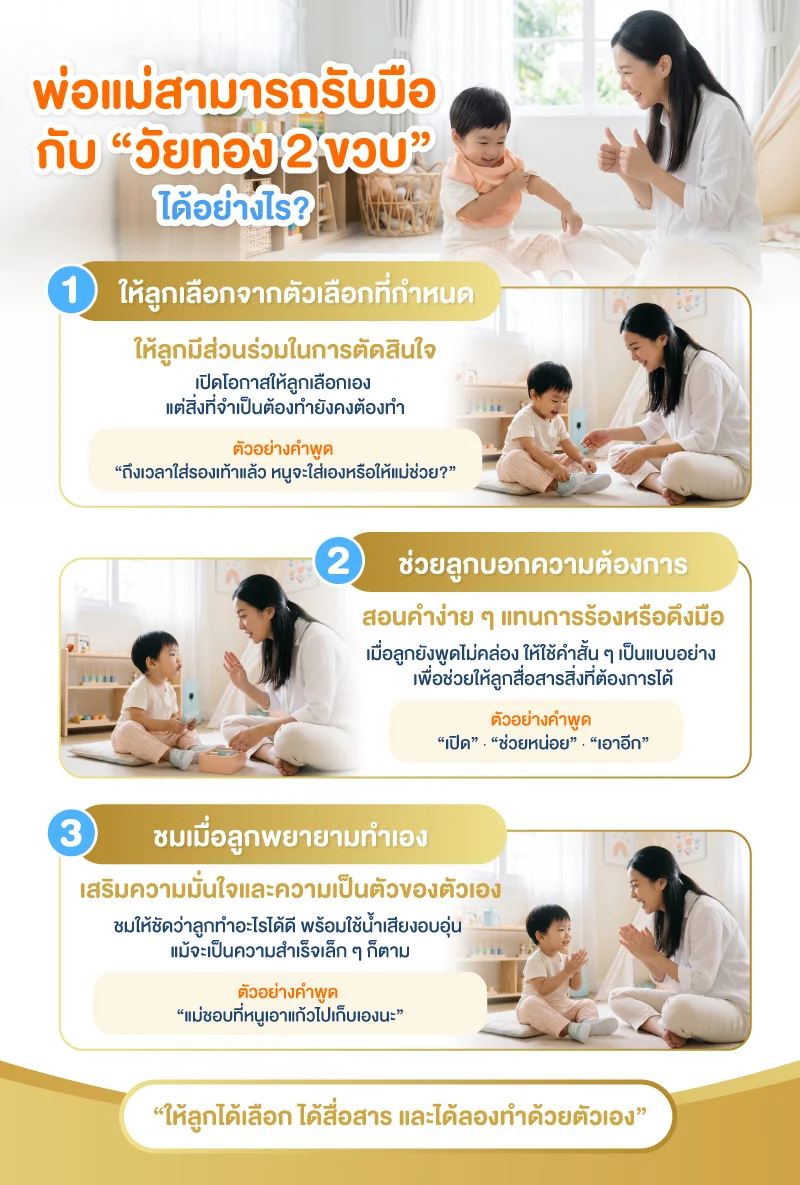
1. Give your child the opportunity to participate in decision-making by offering a limited number of options.
Closed choices involve giving children options that adults have predetermined, allowing them to participate in decision-making within clear boundaries. For example, “Do you want the blue cup or the green one?” or “Do you want to walk to the bathroom by yourself or hold Mom’s hand?”
Giving children limited choices allows them to participate in decision-making while adults clearly define the boundaries of what needs to be done. For example, when it’s time to leave the house, a child might choose whether to put on their shoes by themselves or have an adult help, but leaving the house is still a requirement. Offering children limited choices aligns with the AAP’s guidelines, which recommend that 2-year-olds be given opportunities to choose from appropriate options [2]
Research on the behavior of preschool children has also found that most children in the study preferred situations in which they had a choice over those in which they did not [5]
2. Create opportunities for your child to express their needs
When a child uses gestures such as pulling on a hand, pointing, or reaching for an object to express a need, adults can model short phrases appropriate for the child’s language level, such as “Help me,” “Open,” or “More,” and can also use accompanying gestures if the child is not yet able to communicate with many words.
Here’s an example of how parents can model effective communication for their child: If a child hands an adult a toy box that they can’t open on their own, parents might say “Open” or “Give me a hand” before helping the child, so the child can hear how to communicate in a way they can use in similar situations in the future.
The goal of modeling speech for children is not to force them to repeat what you say in order to receive help, but to help them gradually learn how to communicate their needs so that those around them can understand and apply this skill in various situations.
3. Watch as your child communicates or tries to do things on their own
When children try to communicate, help themselves, or cooperate during activities, parents can respond with praise and positive attention to encourage the behaviors they want to see more often [2]
Praise doesn’t have to be long or complicated. Parents can clearly state what they’re praising, such as, “I like that you put the cup away by yourself,” or “I like that you asked for help,” while using a warm tone of voice, a smiling expression, and showing positive attention toward their child.
When should you consult a specialist about the development of a 2-year-old?
Refusing to do things on their own or throwing tantrums when they don’t get what they want are behaviors commonly seen in 2-year-olds. However, the “terrible twos” should not be used as an excuse to overlook developmental concerns. If parents are concerned that age-appropriate skills have not yet emerged, or especially if their child has lost skills they previously possessed, they should speak with a pediatrician or a developmental specialist and inquire about screening or further evaluation [1]
Age-appropriate developmental checklists are designed to help monitor development; they are not intended for diagnosis. Therefore, parents do not need to wait until they have multiple concerns before seeking advice from a specialist [1]
, Ph.D., Khotawanich
Written by:
, M.Ed., Special Education, Board Certified Behavior Analyst (BCBA)
, Ph.D., Khotawanich
M.Ed., Special Education, Board Certified Behavior Analyst (BCBA),
Written by:
, Ph.D., Khotawanich
, M.Ed., Special Education, Board Certified Behavior Analyst (BCBA)
Ackerlund Brandt JA, Dozier CL, Juanico JF, Laudont CL, Mick BR. The value of choice as a reinforcer for typically developing children. Journal of Applied Behavior Analysis. 2015;48(2):344–362. doi:10.1002/jaba.199. https://doi.org/10.1002/jaba.199
The desire to explore, try new things, and make more choices and decisions on their own is common among 2-year-olds, as they are developing their motor skills, communication abilities, and sense of self [2,3]. Saying “no” or refusing requests may therefore be part of typical behavior during the “terrible twos,” but it doesn’t mean your child is being defiant every time.
Two-year-olds may not yet play much with their peers. They may be interested in other children and approach them to play nearby, but they still tend to play on their own. Learning to share, take turns, and play together requires time and practice. As a result, children may occasionally share, take turns, or play with their peers, but they do not do so consistently [4]
If you, as parents, are concerned that your child has not yet begun to develop age-appropriate skills, or if you notice that your child has lost skills they previously had, you should consult a specialist and inquire about additional developmental screening or assessment. There is no need to wait until multiple concerns arise at the same time [1]