





A mother feeds her young child rice on a high chair, alongside a gold plaque and the GOS Bio-active icon. What does "GOS" stand for? By Dr. Worawit Kanthamali

What Is GOS Bio-active? Prebiotics forYour Baby’s Gut and the Evidence We Have Today

What is GOS Bio-active?

Bioactive GOS (galacto-oligosaccharides) are short-chain carbohydrates belonging to the group of soluble dietary fiber that the human body cannot digest [1]. Once they reach the large intestine, they serve as food for microorganisms, known as prebiotics, particularly Bifidobacterium (bifidogenic effect) [1, 2]

Where will my child get GOS Bio-active from?

Breast milk is rich in human milk oligosaccharides (HMOs), which are the third most abundant component of breast milk, whereas cow’s milk contains very little of them [1]. GOS is not an HMO, but it has a partially similar structure, so it can be added to formula to make itmore similarto breast milk[1].

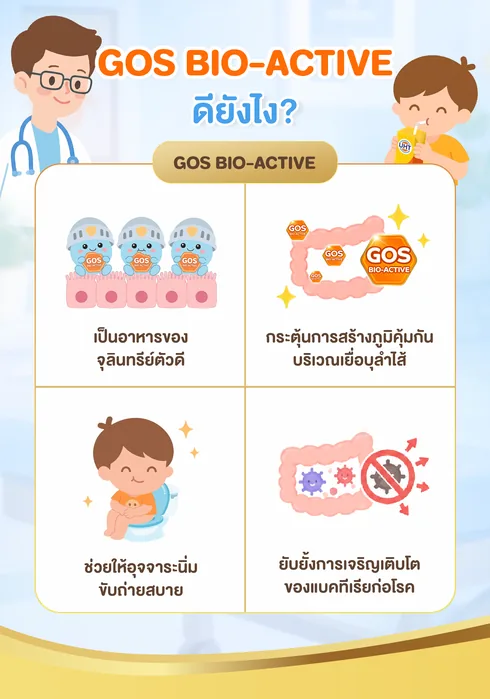
Infographic: How Does GOS Bio-active Work? 1. It serves as food for beneficial bacteria. 2. It stimulates the development of the immune system in the intestinal mucosa. 3. It helps soften stools and promotes comfortable bowel movements. 4. It inhibits the growth of pathogenic bacteria.

Comparison of Energy Fields: Regular Dietary Fiber vs. GOS Bio-active

PerspectiveGeneral Food FiberGOS Bioactive
GoalClears out waste buildup in the colon and increases stool bulk [1]Serves as a food source for beneficial bacteria (bifidogenic effects) [2]
Immune responseHas no direct effect on immune cells [3, 4]Stimulates the production of secretory IgA in the intestinal mucosa [3]
Characteristics of StoolHelps with mobility but may cause stiffness if dehydrated [1]Helps soften stools and promote comfortable bowel movements[1, 2]
Protection against pathogensReduce fecal retention time [1]Helps reduce the risk ofgastrointestinalinfections[1,3]

Why has GOS Bio-active won over pediatricians?

  • Step 1: Cultivate beneficial bacteria: Adding GOS Bio-active or a GOS/FOS blend to boxed milk increases the levels of Bifidobacterium and Lactobacillus, according to several studies [1]
  • Step 2: Increases short-chain fatty acids (SCFAs) and lowers stool pH: Microorganisms ferment bioactive GOS to produce short-chain fatty acids (SCFAs), which help retain water , soften the stool into well-formed stools, and facilitate easy passage. Meanwhile, the lower stool pH helps reduce pathogenic bacteria. A study in infants reported a decrease in Clostridium difficile in stool [1]
  • Step 3: Strengthening the First Line of Defense (Secretory IgA Enhancement) Since 70% of the immune system is located in the gut, GOS Bio-active helps stimulate the production of secretory IgA antibodies to trap foreign substances and virusesbefore they enter the bloodstream[3]
  • Step 4: Competing for space on the intestinal wall and reducing inflammation in the intestines. The proliferation of beneficial bacteria helps colonize the intestinal wall, preventing harmful bacteria from attaching to it and thereby reducing the risk ofgastrointestinal infections[1, 3]

summarize

GOS Bio-active is a prebiotic with evidence showing that it helps increase beneficial bacteria, regulate pH levels , produce short-chain fatty acids, and make the stool characteristics of formula-fed infants similar to those of breastfed infants [1], and it is highly safe [1]

Dr. Worawit Kanthamali, author of the article

Dr. Worawit
Kanthamali

Written by:


, Pediatric Infectious Diseases, Phyathai 3 Hospital

Dr. Worawit Kanthamali, author of the article

Dr. Worawit
Kanthamali


, Pediatric Infectious Diseases, Phyathai 3 Hospital

Dr. Worawit Kanthamali, author of the article

Written by:

Dr. Worawit
Kanthamali


, Pediatric Infectious Diseases, Phyathai 3 Hospital

reference

  1. Vandenplas Y, Zakharova I, Dmitrieva Y. Oligosaccharides in infant formula: further evidence supporting the role of prebiotics. British Journal of Nutrition. 2015;113(9):1339-1344. doi:10.1017/S0007114515000823
  2. Ambrogi V, Bottacini F, O’Callaghan J, et al. Infant-Associated Bifidobacterial β-Galactosidases and Their Ability to Synthesize Galacto-Oligosaccharides. Frontiers in Microbiology. 2021;12:662959. doi:10.3389/fmicb.2021.662959
  3. Xi M, Hao G, Yao Q, Duan X, Ge W. Galactooligosaccharide Mediates the NF-κB Pathway to Improve Intestinal Barrier Function and Intestinal Microbiota. Molecules. 2023;28(22):7611. doi:10.3390/molecules28227611
  4. Arslanoglu S, Moro GE, Boehm G. Early supplementation with prebiotic oligosaccharides protects formula-fed infants against infections during the first 6 months of life. The Journal of Nutrition. 2007;137(11):2420-2424. doi:10.1093/jn/137.11.2420

View more product details

Share

Accumulate purchase points, upgrade your membership level, and receive exclusive additional discounts.

Members can use discount coupons at checkout when purchasing items totaling 1,000 baht or more.

The first 220 orders: Spend 1,190.- and get a free Omega Smart Drawing Board (valued at 299.-)!
The first 150 orders: Spend 3,190.- and get a free Omega Dream Piano Set (valued at 890.-)!
Valid only from November 16–30, 69

Add to cart now! Get an instant discount of 20 baht per case on Foremost Omega 369 Original Flavor, 180 ml.